Welcome to the Greenhouse Gas Research Group (GGRG) based at Royal Holloway Earth Sciences Department. On this site you will find information about the laboratory, our facilities and details on how you can work with us either in collaboration or as a research student through applying for available projects.
The aims of the Greenhouse Gas Research Group:
- To further understand and quantify the background greenhouse gas emissions entering the UK and Europe.
- To understand the importance of varying sources of greenhouse gases to the Arctic and the seasonality of those sources.
- To continue to monitor UK, Arctic and Atlantic greenhouse gas emissions and upgrade facilities where possible.
- Provide assisted services to the scientific community, with focus on the determination of carbon isotopes on CO2 and CH4 to determine likely sources of greenhouse gases.
- Collaborate globally to help to provide a worldwide greenhouse gas monitoring network.
A very brief overview of the science involved
Methane is the second most important greenhouse gas in terms of total radiative forcing (after CO2), but has a relatively short lifetime in the atmosphere of 8.4 years. This makes it an excellent target for mitigation as improvements can be seen on a political timescale. Currently, global concentrations of methane in the atmosphere are rising rapidly and the source of the extra methane is not certain.
There are three isotopes of Carbon: masses 12 and 13 are stable, mass 14 is radiogenic and processes such as biological uptake, temperature of formation, oxidation can all preferentially use one isotope over another.
We measure the two stable and most common isotopes 12C and 13C using Isotopic analysis-GC-Continuous Flow- Mass Spectrometry. The 13C:12C ratio (termed δ13CCH4) in a sample of methane is therefore controlled by the process(es) by which it was formed. From previous work by ourselves and many others, we now know the isotopic fingerprint of many of the main methane sources and can use them to help identify an unknown source.
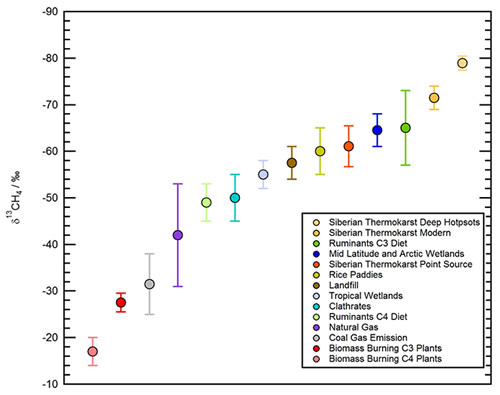
The “isotopic fingerprint range” of a selection of methane sources. By measuring the δ13CCH4 in
an air sample we can begin to eliminate potential sources of methane
from an unknown source. Some source fingerprints overlap, so we also
have to use complementary methods such as air mass trajectory models or
hydrogen isotope measurements to definitively identify a source.
The main focus of the Royal Holloway Greenhouse Gas Research Group
(GGRG) is to measure isotopes of carbon in methane to help identify
sources, as well as quantifying the changing amounts of methane in the
atmosphere over time.
The group has current NERC funded projects investigating Global Methane, North Sea emissions, Urban methane and also methane remediation. We also work with industrial partners measuring landfill emissions using our mobile greenhouse gas measurement equipment.
The laboratory and staff are available for commercial air sample processing for CO2, CH4 and δ13C and for site measurements utilising our range of mobile and portable monitoring equipment. Please contact us to use the facilities either for commercial work or collaborations.